+ Creative Direction
+ Brand & Campaign Strategy
+ AI Workflow Design
+ Art Direction
+ Digital & Print Systems
Olio is a conceptual online design shop developed as a full-spectrum, AI-enhanced brand and campaign system.
The project explores how artificial intelligence can be embedded across research, branding and campaign production without compromising clarity, craft or brand integrity.
Year
2025
Client
Olio
Website
www.olio.io
Overview
Olio was developed as part of an AI Lead Creative assessment, with the aim of designing a brand system that could scale across channels, formats, and campaign moments.
Rather than treating AI as a stylistic generator, the project positions it as a supporting layer within a clearly defined creative framework. Strategic thinking, visual direction, and quality control remain human-led, while AI is used to support iteration, variation, and production efficiency.
The system was designed to live consistently across evergreen brand communications, promotional campaigns, digital advertising, landing pages, email, UGC-style assets, and print-like formats.
Challenge
The challenge was to design a brand that could operate at volume without visual drift.
Olio needed to support long-term brand presence alongside high-pressure commercial moments such as Black Friday, while remaining flexible enough to evolve across channels including digital ads, social, landing pages, email, UGC and print formats.
The core task was not speed, but control: defining a system where AI could assist scale without eroding tone, hierarchy, or recognisability.


Approach & Process
Conducted creative brand and category research to define positioning, tone and quality benchmarks
Designed a restrained brand identity system focused on hierarchy, consistency, and longevity
Defined product imagery as the primary source of truth across all executions
Established layout, cropping, and typographic rules to govern variation
Integrated AI into controlled regeneration workflows rather than open-ended generation
Built modular systems for evergreen ads, campaigns, banners, UGC, and editorial outputs
Tested multiple AI tools in parallel, selecting outputs based on realism and production readiness
Creative Strategy
The Olio brand is built around quiet confidence, material honesty, and intentional design.
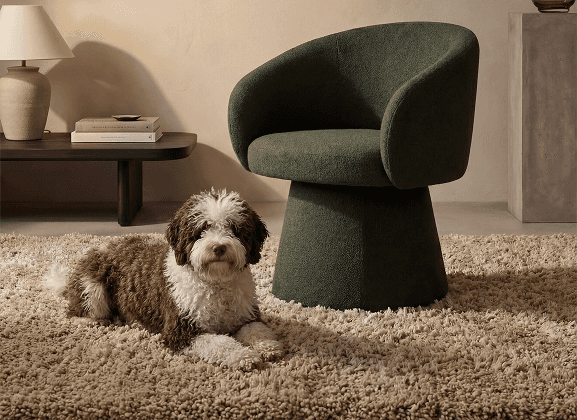
Rather than relying on frequent stylistic shifts, the system prioritises consistency of product, environment, and tone. Variation is introduced through layout logic, framing, scale, and the presence of human or animal elements, allowing the brand to evolve naturally while remaining recognisable.
Promotional moments are handled through hierarchy and copy rather than visual noise, ensuring campaign activity does not undermine long-term brand equity.
AI Integration Approach
AI was treated as a system component rather than a shortcut.
A clear hierarchy was established:
Product imagery as the source of truth
Environment and framing as flexible variables
Typography and layout governed by fixed design rules
AI used for controlled regeneration, not randomisation
This structure ensured that outputs remained brand-led, scalable, and production-ready across formats and channels.


Tools & Workflow
ChatGPT 5.1 / 5.2 — strategy, prompting, iteration logic
Gemini 3 — visual ideation and prompt comparison
Weavy + Nano Banana Pro — image generation and refinement
Kling AI 2.5 / 2.6 — motion testing and video exploration
Figma — layout systems, auto-layout, scaling logic
Photoshop & Illustrator — refinement and asset control
Outcome
Olio demonstrates how AI can support a comprehensive brand and campaign system when guided by clear creative direction.
By treating AI as a collaborator within a structured framework, it becomes possible to scale production across channels and formats without sacrificing clarity, consistency or long-term brand value.
Impact & Reflection
Working with AI on this project reinforced how quickly the landscape is evolving. Tools that feel advanced today can feel outdated within weeks, which makes attachment to any single model counterproductive.
The value of AI emerged through continuous testing, comparison, and constraint-driven decision-making. Quality remained the primary metric throughout. If outputs were not convincingly real or production-ready, the direction was reassessed rather than forced.
The project highlights the role of creative leadership in AI-driven workflows: defining intent, setting boundaries, and knowing when not to use the technology.